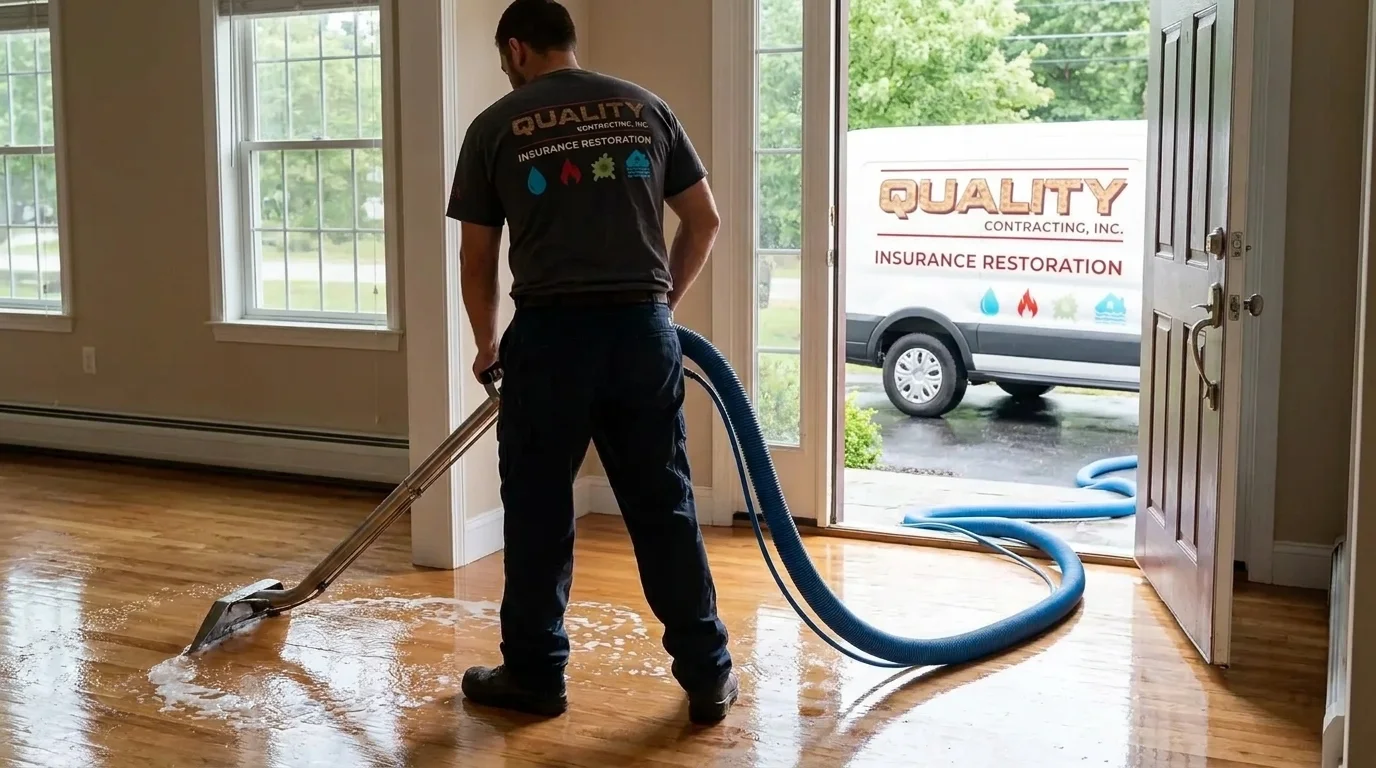
Emergency Flood Damage Restoration in Auburn
Emergency flood damage restoration in Auburn and surrounding areas. Insurance billing accepted. Call (508) 756-8800.
Flooding in your Auburn home? Call (508) 756-8800 for prompt scheduling and emergency service. Flood damage behaves differently than a single burst pipe: the water usually enters from outside, through a foundation crack, a failed sump pump, or storm runoff that overwhelms the grading around your home, and it often carries silt, lawn chemicals, or sewage backflow with it. That changes how the materials are treated and what has to come out of the structure versus what can be dried in place.
What flood damage restoration actually involves
Flood damage restoration covers the extraction, drying, and sanitizing of a structure after water enters from an external source rather than a plumbing failure. Because floodwater is classified as contaminated (Category 3) in almost every case, the work isn’t just pulling water out with a pump. Porous materials that absorbed that water, carpet, pad, drywall up to the waterline, batt insulation, often can’t be saved and have to be removed rather than dried. Crews use truck-mounted or portable extraction units first, then set up axial fans and low-grain-refrigerant dehumidifiers sized to the cubic footage of the affected space, not just the square footage. Monitoring continues over several days with moisture meters and thermal imaging to confirm that wall cavities, subfloor, and framing have actually released their moisture, not just the surface.
Our process
- Safety and contamination assessment. Before anything else, the crew checks for electrical hazards, structural compromise, and confirms the water category so the right PPE and containment protocols are used.
- Bulk water extraction. Standing water is pumped and vacuumed out, prioritizing rooms with the deepest water and any areas where electrical systems are at risk.
- Removal of unsalvageable materials. Saturated drywall, baseboards, carpet, pad, and insulation that contacted contaminated water are cut out and bagged for disposal, typically to a consistent height above the visible waterline.
- Structural drying with daily monitoring. Dehumidifiers and air movers run until moisture readings in framing and subfloor return to a dry standard, with readings logged to document progress for the insurance file.
- Antimicrobial application and pre-reconstruction verification. Affected framing and remaining materials are treated, and the space is checked before any drywall, flooring, or trim goes back in.
What separates a good flood response from a bad one
The most common mistake is drying a flooded space without removing the materials that should have come out. Carpet pad, for example, almost never survives contact with floodwater, and drying it in place just traps contamination between the subfloor and the carpet. Insulation behaves the same way: once wet, fiberglass batt loses its R-value and holds moisture against the framing long after the surface looks dry.
Adjusters reviewing a flood claim look for moisture logs showing day-by-day readings, photos of material removal before drying began, and documentation of the water source and category. A rushed job that skips this paperwork, or dries over contaminated material to save time, tends to resurface as a mold claim within a few weeks. Hidden moisture in sill plates and joist bays is the other place corners get cut; it takes longer to dry and is easy to miss without thermal imaging.
What does flood damage restoration cost?
Flood restoration costs scale with how much water entered, how long it sat, and how much material has to be removed rather than just dried. These are typical industry ranges, not a quote: every loss is different, and QCI Restoration provides a written scope of work before any work begins. Homeowners insurance typically does not cover flood damage from external water sources unless you carry a separate flood policy (often through NFIP), while damage from an internal source like a failed sump pump may fall under your standard policy, so it’s worth confirming coverage type before assuming what’s paid.
| Scenario | Typical range |
|---|---|
| Basement flood, clean water, partial finish | $2,000 - $5,000 |
| Crawlspace flood with insulation removal | $3,000 - $7,000 |
| Whole first floor, groundwater intrusion | $8,000 - $20,000 |
| Multi-room flood with drywall and flooring removal | $10,000 - $25,000 |
| Severe flooding requiring structural drying and reconstruction | $25,000+ |
Seasonal & regional considerations
Auburn and the surrounding Worcester County towns see two distinct flood risk windows: spring snowmelt combined with rain-on-frozen-ground runoff, and late-summer storm systems that can drop a lot of rain fast on saturated soil. Many homes in this area have older fieldstone or block foundations that were never fully waterproofed, which means seepage during heavy rain is common even without a dramatic storm event. Freeze-thaw cycles through a New England winter can also open new cracks in foundations that were fine the year before, so a basement that’s never flooded can start taking on water after a hard winter.
Service area
QCI Restoration handles flood damage restoration in Auburn and nearby communities including Worcester, Oxford, Spencer, Shrewsbury, and Webster.
If water has come into your home from outside, don’t wait on the drying. Schedule your flood damage assessment with QCI Restoration and get a written scope before any demolition or drying work starts.
Services We Handle
- Emergency Flood Cleanup
- Emergency Flood Damage
- Flood Restoration
Frequently Asked Questions
Does homeowners insurance cover flood damage restoration?
Why does carpet and padding usually have to be removed after a flood instead of dried in place?
How long does structural drying take after a flood compared to a simple leak?
What should I do with belongings before the crew arrives?
How soon does mold become a risk after a flood?
Looking for the best flood damage restoration company in Auburn?
QCI Restoration provides flood damage restoration in Auburn, MA and the surrounding area. Customers rate us 4.5 out of 5 stars across 121 Google reviews. We answer calls 24/7 — call (508) 756-8800 for immediate help.
Need Flood Damage Restoration now?
We respond 24/7 across Auburn and surrounding MA cities.