Commercial Restoration in Auburn
Commercial restoration in Auburn and surrounding areas. Insurance billing accepted. Call (508) 756-8800.
Water in a stockroom or smoke in a break room doesn’t stay a small problem. A pinhole leak in a second-floor office suite can soak the ceiling tiles and wiring of the tenant below before anyone notices. A grease fire in a restaurant kitchen can leave a dining room unusable from smoke alone, even when the flames never reached it. Commercial losses carry a cost residential ones don’t: every day a storefront, office, or unit sits closed is lost revenue, missed rent, or a lease clause you’re now explaining to a tenant. QCI Restoration works with property owners, managers, and tenants across Auburn to get commercial spaces documented, stabilized, and back toward reopening.
What commercial restoration actually involves
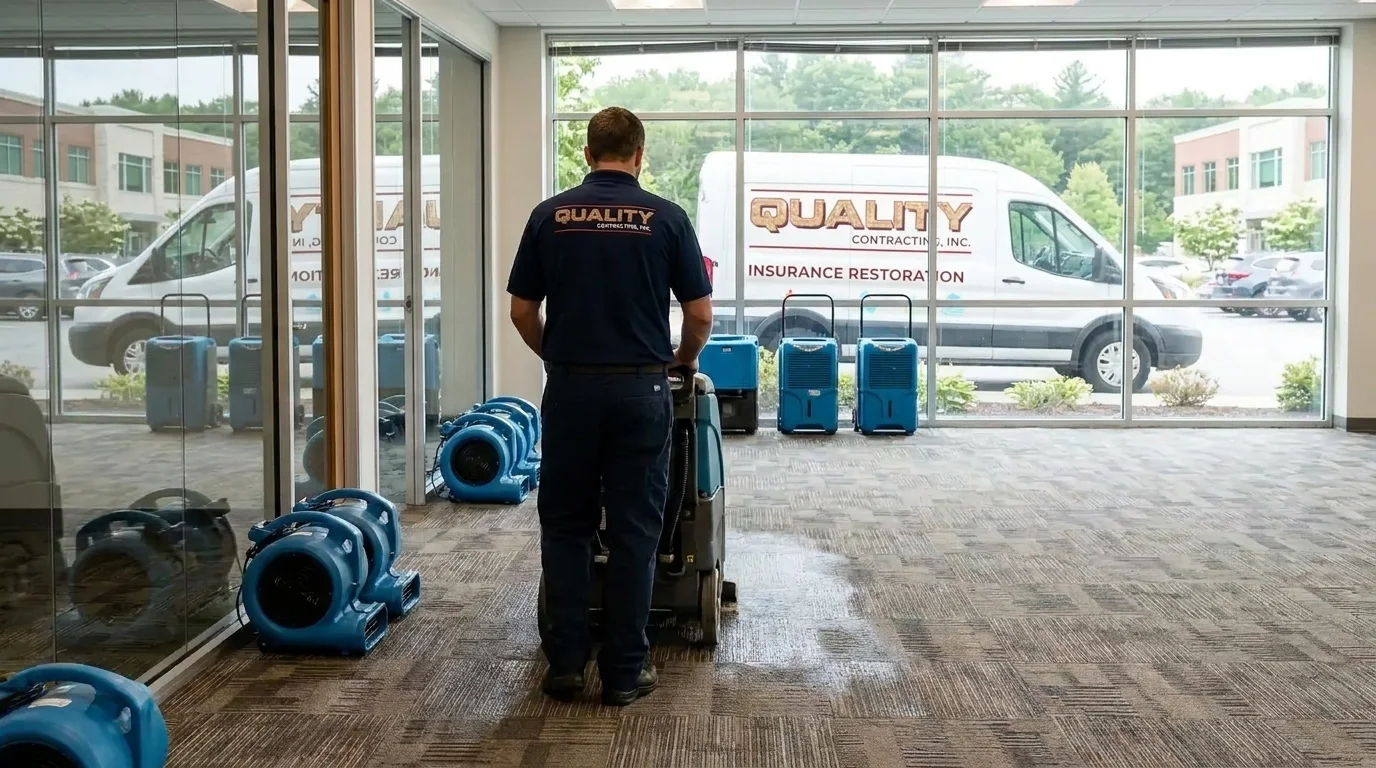
Commercial restoration covers water, fire, and smoke losses in office buildings, retail storefronts, restaurants, warehouses, and multi-tenant properties. The scale and stakes differ from a house call: a water loss in a 20,000-square-foot warehouse needs commercial-grade desiccant dehumidifiers and dozens of air movers, not a handful of residential units. A kitchen fire in a leased restaurant space has to be scoped around the landlord’s structure, the tenant’s equipment and fixtures, and often a certificate of occupancy before the doors can reopen. Work has to account for multiple stakeholders, insurance policies that may be split between building owner and tenant, and sometimes a business income claim running alongside the property claim. Timelines vary with the loss, but most commercial jobs move faster when access, utilities, and decision-makers are sorted out on day one.
Our process
- Site assessment and loss documentation. Photographing and mapping the affected area, measuring moisture in walls and flooring or characterizing soot type, and noting pre-loss condition for the insurance file.
- Containment and stabilization. Isolating the damaged area from occupied or still-open parts of the business, boarding or tarping openings, and setting temporary power where needed so equipment can run safely.
- Extraction, drying, or soot and odor removal. Water is pulled and the structure is dried per the IICRC S500 standard with moisture monitored daily; fire and smoke losses get cleaned and treated based on soot type and how far odor has traveled into HVAC or porous materials.
- Reconstruction coordination. A written scope of work, permitting where required, and phased scheduling so parts of the business can reopen before the entire job is finished.
- Final walkthrough and documentation handoff. Moisture logs, photos, and scope documents are packaged for the insurance carrier and the property owner or tenant’s records.
What separates a good commercial response from a bad one
The mistakes that cost businesses the most time usually aren’t visible on day one. Moisture behind a retail display wall or under a raised restaurant floor can read dry at the surface while the substrate underneath stays wet for weeks, leading to a mold callback months later. A rushed scope that skips daily moisture logs gives an adjuster nothing to verify drying progress against, which slows claim approval. On fire losses, treating all soot the same is a common shortcut: protein soot from a kitchen fire behaves differently than synthetic soot from burned plastics and wiring, and using the wrong cleaning agent can set odor into materials rather than lift it out. Good commercial work also means sequencing repairs so a business can reopen part of its space while the rest finishes, rather than closing the whole property until every last item is done.
What does commercial restoration cost?
Commercial restoration costs vary widely based on square footage, the category of water or severity of fire, and how many trades are involved in putting the space back together. These are typical industry ranges, not a quote: every loss is different, and QCI Restoration provides a written scope of work before any work begins. Most commercial property policies cover sudden water and fire losses, and many also include business income coverage, though specifics depend on the policy.
| Scenario | Typical range |
|---|---|
| Single office suite, clean water loss | $2,500 - $7,000 |
| Retail storefront, smoke and odor only | $4,000 - $12,000 |
| Restaurant kitchen fire with equipment loss | $15,000 - $50,000+ |
| Multi-tenant common area water damage | $8,000 - $25,000 |
| Warehouse, large-area water extraction and drying | $10,000 - $40,000 |
Seasonal & regional considerations
Auburn and the surrounding Worcester County towns see hard winters, and many commercial buildings here, especially older mixed-use properties, still run original cast-iron or galvanized plumbing that’s prone to freezing in unheated stockrooms or vacant suites. Flat commercial roofs common on retail and office buildings are also vulnerable to ice damming after heavy snow, which shows up as water damage along interior walls weeks after the storm. Summer humidity raises the stakes on any water event that isn’t dried quickly, since mold can begin colonizing untreated materials within 24 to 48 hours.
Service area
QCI Restoration handles commercial restoration for businesses and property managers in Auburn and nearby communities including Worcester, Shrewsbury, Oxford, and Spencer.
If water or fire has closed part of your business, don’t wait on the damage to spread while you’re still sorting out next steps. Call (508) 756-8800 to schedule a commercial restoration assessment and get a written scope of work started.
Frequently Asked Questions
Does commercial property insurance cover water or fire damage restoration?
Can part of my business stay open while restoration work is happening?
Who handles the claim when a loss involves both the landlord and a tenant?
How is a commercial water or fire loss different from a residential one?
What slows down reopening after a commercial fire or water loss?
Looking for the best commercial restoration company in Auburn?
QCI Restoration provides commercial restoration in Auburn, MA and the surrounding area. Customers rate us 4.5 out of 5 stars across 121 Google reviews. We answer calls 24/7 — call (508) 756-8800 for immediate help.
Need Commercial Restoration now?
We respond 24/7 across Auburn and surrounding MA cities.